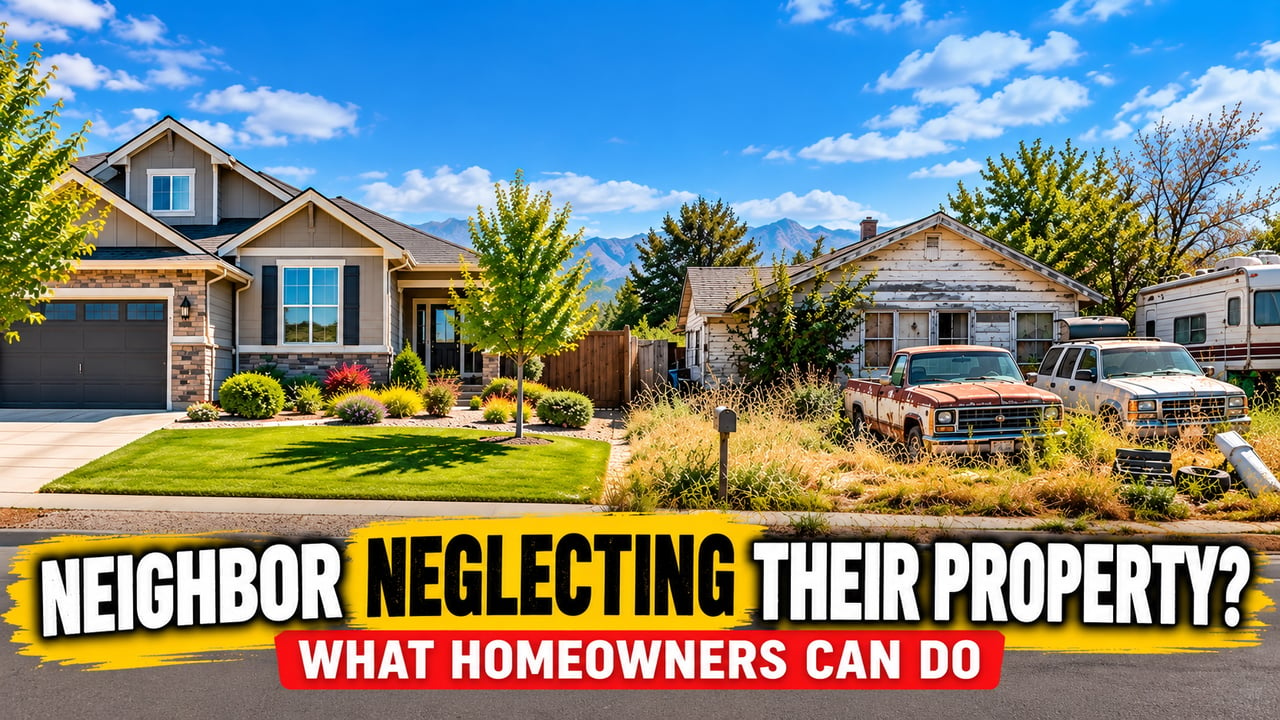
What Can You Do When a Neighbor Neglects Their Property? A Homeowner’s Guide
Homeownership Scott Coddington October 4, 2026
Homeownership Scott Coddington October 4, 2026
Overgrown weeds, junk in the yard, broken-down vehicles, or a deteriorating home next door can be frustrating—and may even affect how buyers perceive your property. But before calling the HOA or Code Enforcement, there may be a better place to start: talking to your neighbor.
One of the lessons I learned growing up was pretty simple:
Get to know your neighbors.
That advice may sound old-fashioned, but I still think it's one of the best approaches to many neighborhood problems.
What happens, though, when the house next door isn't being maintained?
Maybe the weeds keep getting taller. There are inoperable vehicles sitting outside. Trash or debris is accumulating. A fence is falling over. The exterior hasn't been maintained for years.
It becomes even more complicated when you're preparing to sell your home—or considering buying a home next to that property.
Do you knock on the door?
Contact the HOA?
Look at the neighborhood covenants?
Call Code Enforcement?
And if you report your neighbor, what does that do to the relationship you'll have with the person living next door?
There's more to consider here than simply determining who's right and who's wrong.
Unless there's an immediate health, safety, or serious legal concern, I'd generally start with the simplest approach:
Talk to your neighbor.
The tone of that conversation matters.
Instead of approaching someone with:
"Your yard looks terrible, and you need to clean it up."
Consider something closer to:
"Hey, I wanted to check in with you. I noticed the yard has gotten a little harder to keep up with lately. Is everything okay?"
You may discover there's more happening than you realized.
Maybe they're elderly and physically struggling with the yard.
Maybe someone is sick.
Maybe they've recently lost a spouse.
Maybe they're dealing with financial problems.
Maybe their lawnmower broke.
Or maybe they simply have a different standard for maintaining their property than you do.
You won't know until you communicate.
Sometimes a neighbor may even appreciate an offer to help.
And sometimes the conversation won't accomplish anything.
That's when it helps to understand what options come next.
If the property is located within a homeowners association, review the HOA's declarations, covenants, rules, and regulations.
Depending upon the community, there may be requirements addressing landscaping, exterior maintenance, fences, vehicles, trash containers, exterior storage, paint, and other visible property conditions.
But remember:
Something being unattractive doesn't automatically make it an HOA violation.
Your neighbor may maintain their property differently than you would while still complying with the community's governing documents.
If you believe there's an actual violation, contacting the HOA or management company may be the appropriate next step. Allow them to determine whether enforcement is warranted.
That can also create some separation between two neighbors personally arguing about what someone should do with their property and an association enforcing rules that apply to everyone in the community.
This is where some homeowners discover the trade-off involved in living outside an HOA.
A lot of people specifically search for homes without an HOA because they don't want someone telling them where they can park an RV, what color they can paint their house, or how their property should be maintained.
There are legitimate reasons for wanting that freedom.
But that freedom works both ways.
Your neighbor generally has more freedom too.
That doesn't mean anything goes. Municipal codes, county ordinances, zoning regulations, nuisance laws, and health and safety requirements can still apply.
But there's an important difference between:
"I don't like what my neighbor is doing."
and
"My neighbor is violating an enforceable ordinance or restriction."
Understanding that distinction can prevent a lot of unnecessary conflict.
There's another situation buyers and homeowners sometimes overlook.
A neighborhood may have recorded restrictive covenants even when there isn't an active HOA collecting dues and sending violation notices.
Those documents may contain restrictions regarding property use, exterior conditions, animals, vehicles, structures, or other issues.
The difficult question becomes:
Who actually has the legal right to enforce those restrictions?
If there isn't an active association, enforcement may not be as simple as filing an HOA complaint.
That's not something I recommend guessing about. If recorded covenants appear relevant and there's no functioning association to enforce them, a Colorado real estate attorney can help determine whether the restrictions remain enforceable and who may have enforcement rights.
Sometimes you've spoken with the neighbor and nothing changes.
Other situations may involve conditions serious enough that speaking directly with the neighbor isn't practical or appropriate.
That's where local Code Enforcement may come into play.
The first thing to determine is which jurisdiction the property is actually located in.
A Colorado Springs mailing address doesn't necessarily mean the property is located within Colorado Springs city limits.
The appropriate agency may be the City of Colorado Springs, unincorporated El Paso County, or another municipality.
Colorado Springs Neighborhood Services handles potential City Code violations involving neighborhood and property conditions.
Issues can include things such as weeds, litter and debris, outside storage, certain vehicle issues, and other property-maintenance concerns covered by City Code.
You can learn more here:
Colorado Springs Neighborhood Services & Code Enforcement
If you've determined that a legitimate potential violation exists and need to submit a complaint, the City also provides an online form:
Submit a Colorado Springs Code Enforcement Complaint
If the property is outside an incorporated municipality and located in unincorporated El Paso County, the County's Planning & Community Development Department handles Code Enforcement.
County Code Enforcement addresses applicable land-use and ordinance violations that can include issues such as excessive weeds, trash and rubbish, inoperable vehicles, and certain property-use violations.
More information is available here:
El Paso County Planning & Community Development — Code Enforcement
If you're uncertain which jurisdiction applies, determine that first rather than submitting a complaint to the wrong agency.
This is where the conversation becomes more complicated.
Just because you can report something doesn't always mean filing a complaint should be your first move.
Remember:
You still have to live next to each other.
Even when a complaint can be submitted without prominently identifying yourself to your neighbor, they may have a pretty good idea where it came from.
That doesn't mean legitimate violations shouldn't be reported.
Dangerous structures, serious accumulation of rubbish, significant health or safety issues, and ongoing code violations may warrant government involvement.
But repeatedly involving an HOA or government agency in minor disagreements can turn a manageable situation into a long-term dispute between neighbors.
Ask yourself:
Am I trying to resolve a legitimate problem, or am I trying to force my neighbor to maintain their property exactly the way I maintain mine?
Those aren't necessarily the same thing.
Potentially, yes—but I wouldn't automatically assign a specific dollar amount to it.
Real estate buyers don't evaluate a house in isolation.
They evaluate the street.
They look at neighboring homes.
They notice landscaping.
They notice parked vehicles.
They notice deteriorating exteriors.
They notice whether the neighborhood appears cared for.
Imagine two nearly identical homes.
One is surrounded by attractive, well-maintained properties.
The other sits next to a property with waist-high weeds, multiple inoperable vehicles, exterior damage, and debris throughout the yard.
Which property creates the better first impression?
Even if an appraiser doesn't simply subtract a predetermined amount because of the house next door, buyer perception can affect marketability.
Some buyers may decide not to make an offer at all.
Others may perceive greater risk and offer less.
The property could potentially take longer to sell.
Ultimately, real estate value is influenced by what buyers are willing to pay, and the surrounding neighborhood contributes to that decision.
If I'm preparing to list a property and there's a visibly neglected home next door, I'd rather address the situation before the For Sale sign goes up.
First, evaluate how noticeable the neighboring condition actually is.
Then consider your options in order.
Have a friendly conversation if appropriate.
Determine whether there's an HOA and whether an actual violation exists.
Review recorded covenants if they're relevant.
If there's a legitimate municipal or county code violation that isn't being resolved, Code Enforcement may be another avenue.
At the same time, focus heavily on something much easier to control:
Your own property.
Make your landscaping look excellent.
Clean and maintain the exterior.
Improve curb appeal.
Repair fences or improvements you control.
Consider landscaping, fencing, or screening where appropriate and permitted.
Make your home stand out positively.
You may not be able to control the property next door, but you can control how your home presents in comparison.
This may be even more important for buyers.
When you're buying a house, you're not just buying the structure.
You're buying the location and becoming part of the neighborhood.
Drive through the area at different times of day.
Look at the surrounding properties.
Pay attention to parking, noise, maintenance, traffic, animals, exterior storage, and how neighboring properties are being used.
If you see something concerning, don't automatically assume:
"The HOA will make them fix that."
or
"I'll just call Code Enforcement after I move in."
Research the situation before purchasing.
Determine whether there's an HOA.
Review the covenants.
Determine whether the condition you're seeing actually violates an enforceable restriction or government ordinance.
And then ask yourself what I think is one of the most important questions a buyer can ask:
If absolutely nothing about that neighboring property ever changes, would I still want to own this house?
That's a much safer way to evaluate the purchase than buying the property based upon the assumption that someone else will eventually force your neighbor to change.
This brings us to an interesting conversation I have with buyers.
Some people absolutely don't want an HOA.
And there are legitimate reasons for that.
HOAs can mean monthly or annual dues, architectural restrictions, rules, enforcement, and less individual freedom over your property.
But there's another side.
Those same restrictions may establish minimum standards for landscaping, exterior maintenance, parking, property condition, and other issues that affect the appearance and consistency of the neighborhood.
Neither option is automatically better.
The question is:
Which trade-off fits you?
If having maximum control over your own property is extremely important, a non-HOA neighborhood may be attractive.
If having more consistent neighborhood standards is important, you may see value in a well-managed HOA.
The key is understanding that trade-off before purchasing, rather than discovering it after moving in.
Rules, covenants, HOAs, and municipal codes all have their place.
But I still come back to something much simpler:
Know your neighbors.
Say hello.
Exchange phone numbers.
Help each other occasionally.
Talk before small problems become large ones.
There will certainly be situations where formal enforcement is necessary.
But when two neighbors can resolve a problem through a conversation instead of violation letters, government complaints, attorneys, or an escalating dispute, there's a good chance both households will be happier living there afterward.
Your home is an investment.
But it's also part of a neighborhood.
Protecting both sometimes requires knowing when to speak up—and knowing how to do it thoughtfully.
Before submitting a complaint, determine whether the property is within Colorado Springs city limits, unincorporated El Paso County, or another municipality because the applicable regulations and enforcement agency may be different.
City of Colorado Springs:
Colorado Springs Neighborhood Services & Code Enforcement
Colorado Springs complaint form:
Submit a Code Enforcement Complaint
Unincorporated El Paso County:
El Paso County Planning & Community Development — Code Enforcement
If your concern involves recorded covenants, property rights, boundaries, easements, enforcement rights, or another legal issue, consider consulting a qualified Colorado real estate attorney.
You've talked with your neighbor. You've checked the HOA. You've reviewed the covenants. You've researched Code Enforcement.
And the house next door still drives you crazy every time you look out the window.
There is, of course, one more option…
You can always move.
If it gets to that point, feel free to give us a call at Pulse Real Estate Group. We'd be happy to help you find a new home—and maybe this time we'll take an extra-long look at the neighbors before you make an offer.
[Search Homes with Pulse Real Estate Group →]
Hopefully, a friendly conversation solves the problem first. But if not, we're here when you're ready for Plan B.
This article is provided for general educational purposes and isn't legal advice. HOA governing documents, recorded covenants, municipal codes, county regulations, enforcement procedures, and individual property circumstances vary.
Homeowners and buyers should independently verify the rules applicable to a particular property with the appropriate HOA, governmental agency, title professional, or qualified Colorado attorney before taking action.
Stay up to date on the latest real estate trends.

Hiking
The Manitou Incline

Southern Colorado Activities
Live Music, Pumpkin Patches, Family Activities & Fall Fun in Colorado Springs, Pueblo & Pueblo West
Homeownership
From talking with your neighbor to HOAs, covenants, and Code Enforcement, learn how to address a neglected property next door—and what it could mean when buying or sel… Read more

Fall Foliage
Best Colorado Springs Neighborhoods for Fall Colors

Homeownership
A Colorado Springs homeowner’s guide to choosing the right landscaping for your lifestyle, water use, maintenance, curb appeal, and future resale.
Buying a Home | Colorado Real Estate
Found a foreclosure on Zillow or Auction.com? Before you bid, understand how Colorado foreclosure auctions work, why you may not be able to inspect the home, and the f… Read more

2026 Relocation Guide
Everything You Need to Know About Housing, Cost of Living, Neighborhoods, Traffic, Taxes, and Life in Colorado Springs
Serving communities from Colorado Springs through Pueblo and Denver, west into the mountains or east to the plains, our team is here to help with all your real estate needs across Colorado’s Front Range.