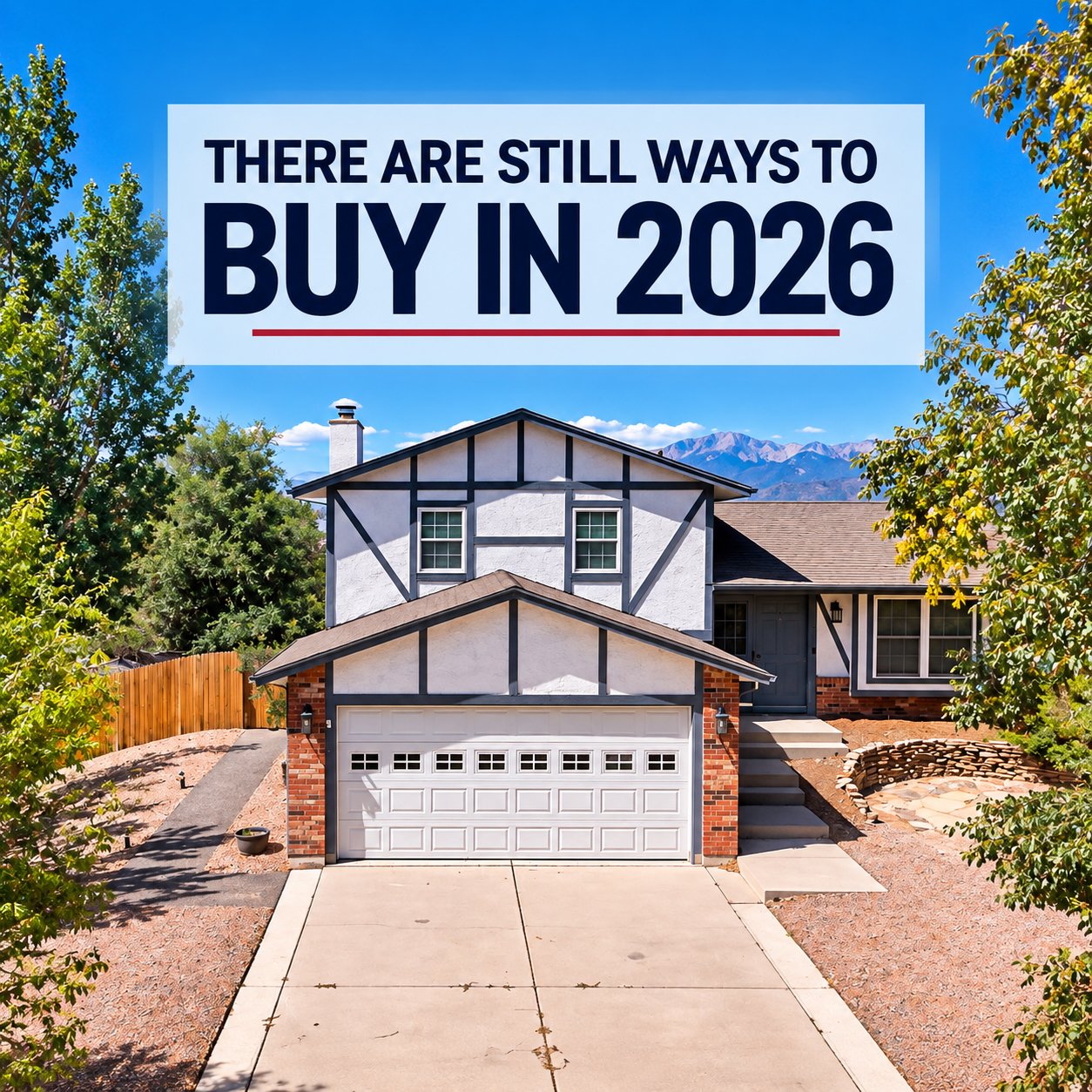
How to Buy a Home When Mortgage Rates Are Above 7%
Mortgage Rates above 7% Scott Coddington September 16, 2026
Mortgage Rates above 7% Scott Coddington September 16, 2026
When mortgage rates move above 7%, it's understandable for buyers to wonder whether purchasing a home still makes sense.
Higher interest rates can have a significant impact on monthly payments and purchasing power. But the rate you see in a headline doesn't necessarily tell you what your actual home-buying options will be.
I'm Scott Coddington, Broker/Owner of Pulse Real Estate Group. I'm a Colorado Springs native, third-generation real estate professional, and I've been licensed in Colorado real estate since 1997.
When interest rates rise, I believe buyers need to become more strategic—not simply more discouraged.
There may be assumable FHA or VA mortgages carrying rates from several years ago. Builders may offer financing incentives below prevailing market rates. Seller concessions may potentially help with closing costs or an interest-rate buydown. Some buyers may benefit from addressing higher-interest consumer debt before purchasing.
And sometimes the right answer is simply that the numbers don't make sense yet.
The objective isn't to convince you to buy a house because rates are high—or convince you to wait because they're high.
It's to understand all of the options available so you can make an informed decision.
When people hear that mortgage rates have moved above 7%, it's easy to focus entirely on that number.
But an interest rate is only one component of your housing expense.
Your actual monthly cost can be affected by the purchase price, down payment, loan program, property taxes, homeowners insurance, mortgage insurance when applicable, HOA dues, metropolitan district expenses, and other costs.
That's why the first conversation should be with a knowledgeable mortgage professional.
Rather than asking:
"What are mortgage rates today?"
Ask:
"Based on my finances and the options available to me, what would my actual monthly payment and cash to close look like?"
That's a much more useful number.
One of the most interesting opportunities in a higher-rate market may already be attached to the house.
Certain FHA-insured and VA-backed mortgages are assumable, subject to the applicable program requirements, approval, and buyer qualification.
Why is that important?
Many homeowners purchased or refinanced their properties when mortgage rates were substantially lower. As a result, some existing FHA and VA loans carry interest rates in the 2% to 3% range.
If a qualified buyer can successfully assume one of those mortgages, the buyer may be able to take over the seller's existing loan and interest rate rather than financing the entire purchase with a new first mortgage at today's rates.
That can potentially create a significant difference in monthly payment.
However, the low interest rate is only part of the equation.
One of the biggest challenges with an assumable mortgage is the difference between the seller's remaining mortgage balance and the purchase price.
For example, suppose a home is selling for $500,000 and the seller has $350,000 remaining on an assumable mortgage at 2.75%.
There's still a $150,000 gap.
The buyer needs a way to address that difference.
For some buyers, that may mean additional cash. Depending on the transaction and the buyer's qualifications, there may also be lenders with financing options that can potentially help address some or all of the gap.
Those financing options can have different rates, terms, costs, lien positions, and qualification requirements, so this is where getting a knowledgeable lender involved early becomes extremely important.
At Pulse Real Estate Group, we can help you identify properties with potentially assumable financing, gather information about the existing mortgage, and evaluate the real estate side of the opportunity.
We can also help connect you with competent local lenders who can evaluate the financing options, including potential solutions when there's a larger gap between the assumable mortgage balance and purchase price.
If you'd like to understand how an FHA or VA assumption might work for your situation, feel free to reach out.
The 2% or 3% interest rate may get your attention, but what really matters is the complete financing structure, cash requirement, and monthly payment.
New construction can present another opportunity when prevailing mortgage rates are higher.
Builders sometimes offer financing incentives through preferred or affiliated lenders.
Depending on the builder, home, loan program, and promotion, those incentives could potentially include a below-market mortgage rate, permanent or temporary rate buydown, closing-cost assistance, design incentives, or a combination of benefits.
This can change the comparison between new construction and an existing home.
Imagine you're considering a $500,000 resale property and a $525,000 new-construction home.
Looking only at the purchase price, the resale property appears less expensive.
But what happens if the builder is offering financing that produces a substantially lower monthly payment?
Now we have a different comparison.
That doesn't automatically make the new home the better purchase.
Builder programs can have qualification requirements, specific closing deadlines, restrictions on eligible homes, and requirements involving a preferred lender.
We need to understand exactly what's being offered.
Don't compare only the price of the homes. Compare the complete financial packages.
When negotiating a resale property, purchase price isn't the only thing that matters.
Depending on the property, seller, financing, and contract, we may potentially negotiate seller concessions.
Eligible concessions may be available to help with certain closing expenses or financing costs, subject to lender and loan-program requirements.
This can create an interesting strategic question.
Suppose a seller is willing to give up $10,000 to make a transaction work.
Would you rather have:
A $10,000 reduction in the purchase price?
Or potentially use some or all of that $10,000 toward eligible closing costs or an interest-rate buydown?
The answer depends on your situation.
A $10,000 reduction in purchase price may not reduce your monthly payment as much as buyers sometimes expect. Using a concession strategically toward financing costs could potentially create a different financial result.
This is something I like having the lender calculate before we structure the offer.
You've probably heard terms such as rate buydown, discount points, or 2-1 buydown.
It's important to understand the difference.
A permanent rate buydown generally involves an upfront cost to obtain a lower interest rate for the loan, subject to the lender's program and terms.
A temporary buydown reduces the effective payment for an initial period before the payment increases to the amount based on the full note rate.
Temporary buydowns can be attractive, but buyers need to understand what happens when the temporary benefit expires.
I don't want a buyer becoming comfortable only with the introductory payment.
Make sure you're comfortable with the full payment as well.
This is one strategy that doesn't receive enough attention.
Before deciding that a 7%+ mortgage makes purchasing impossible, look at all of your monthly financial obligations.
Some buyers may have credit cards, vehicle loans, personal loans, or other debts carrying interest rates considerably higher than the prospective mortgage rate.
Imagine you're currently paying several hundred—or even $1,000 or more—each month toward various consumer debts.
Depending on your financial situation, reducing or eliminating some of those higher-interest obligations before purchasing could potentially improve your overall monthly cash flow.
That doesn't mean everyone should immediately empty their savings account to pay off debt.
You still need to consider your down payment, closing costs, emergency reserves, moving expenses, repairs, furnishings, and the money you want available after purchasing.
The point is to look at the entire financial picture.
Instead of asking only:
"Can I afford a mortgage at 7%?"
Consider asking:
"What will my total monthly financial obligations look like after purchasing the home?"
For some buyers, paying off higher-interest debts before purchasing may mean their overall monthly obligations are more manageable—even with a mortgage rate that's higher than the rates available several years ago.
For other buyers, preserving their available cash may be the better strategy.
There's no universal answer.
Your existing monthly debt obligations can also affect how much you qualify to borrow.
Mortgage lenders generally evaluate a borrower's debt-to-income ratio as part of the qualification process.
Reducing or eliminating certain monthly obligations may potentially change that calculation.
But there's an important point here:
Talk with your lender before paying off accounts.
Don't assume paying off a particular credit card, vehicle loan, or other account will automatically improve your mortgage application.
The effect can depend on the type of debt, remaining payments, loan program, credit profile, available assets, and other factors.
A good lender can run different scenarios before you move money around.
Sometimes eliminating a debt makes sense.
Sometimes keeping additional cash available for the transaction makes more sense.
Run the numbers first.
It's common to hear buyers say:
"I'm just going to wait until rates come back down."
Waiting is certainly an option.
But we don't know with certainty what mortgage rates will do six months, a year, or several years from now.
They could decline.
They could remain relatively similar.
They could move higher.
I'm not interested in trying to predict that for you.
Other things can change as well.
Home prices, available inventory, seller motivation, builder incentives, buyer competition, your income, your savings, and your personal circumstances may all look different in the future.
Rather than trying to predict the mortgage market, I prefer asking:
Does purchasing a home make financial and practical sense for you based on the opportunities available today?
If it doesn't, waiting may make sense.
If it does, then we can investigate the available options.
You've probably heard the phrase:
"Marry the house and date the rate."
I'd be careful with that advice.
If mortgage rates decline in the future, refinancing may potentially provide an opportunity to lower your payment.
But there's no guarantee that rates will decline on a particular timeline or that you'll qualify to refinance when they do.
Your future credit, income, employment, property value, equity, loan program, refinancing costs, and prevailing mortgage rates can all affect that decision.
I don't want someone purchasing a home they can't comfortably afford today because they're depending on a future refinance.
A future refinance can be a potential opportunity. It shouldn't be the requirement that makes today's purchase affordable.
Sometimes the solution isn't a special financing program.
It may simply be changing the home search.
Perhaps we lower the target purchase price.
Maybe we compare a townhome with a detached property.
Maybe new construction becomes more attractive because of builder financing.
Or perhaps we expand the geographic search.
Pulse Real Estate Group has access to multiple MLS systems covering a broad portion of Colorado, allowing us to search from the Denver area through Colorado Springs and Pueblo, into Cañon City and the Royal Gorge region, west into the mountains, and east onto the plains.
That geographic flexibility can matter.
A buyer searching in Colorado Springs might also compare Monument, Black Forest, Falcon, Fountain, Security-Widefield, Pueblo West, Woodland Park, Divide, Cañon City, Florence, Penrose, or other surrounding communities depending on their work, budget, and lifestyle.
Sometimes moving the search 20 or 30 miles changes the available properties considerably.
There are trade-offs, of course.
Commute, utilities, taxes, insurance, HOA or metropolitan district costs, weather, and access to services can all change.
That's why we compare the whole property and lifestyle—not just the price.
Higher interest rates can sometimes reduce the number of buyers competing for certain properties.
That doesn't mean every seller will negotiate.
But a home that's been on the market longer, experienced a price reduction, or received limited buyer activity may provide opportunities that weren't available in a highly competitive market.
The question isn't simply:
"How far below asking price can we offer?"
I want to understand what might be important to the seller.
Perhaps price is their biggest concern.
Maybe they're more receptive to providing a concession.
Perhaps timing, closing date, or possession matters.
Understanding both sides can help us structure an offer that gives the buyer something valuable while still creating a transaction the seller is willing to accept.
This is where I think buying in a higher-rate market becomes particularly interesting.
Suppose you're considering three homes.
Home A has the lowest purchase price but requires traditional financing at the prevailing rate.
Home B costs more but the builder is offering a significantly better financing package.
Home C is a resale property with a potentially assumable FHA or VA mortgage carrying a much lower interest rate.
Which is the best financial opportunity?
We can't determine that from the listing prices.
We need to understand the loan amounts, rates, additional financing, down payment, closing costs, taxes, insurance, HOA expenses, and actual monthly payments.
That's why I like working closely with the buyer's lender.
Let the lender calculate the financing scenarios while we evaluate the properties and negotiate the real estate transaction.
This is one of the most important concepts for buyers to understand.
Purchase price matters.
But so do financing and terms.
If we're able to negotiate $10,000 from a seller, there may be several ways to structure that benefit depending on the contract and financing.
Should we negotiate the purchase price?
Could some of it potentially be used toward eligible closing expenses?
Would an eligible rate buydown have a greater impact?
Which option best preserves the buyer's cash?
There isn't one answer that applies to everyone.
The best deal isn't always the lowest purchase price. It's the combination of price and terms that best accomplishes your goals.
Maybe.
That's intentionally not a yes-or-no answer.
A mortgage rate above 7% doesn't automatically make buying a bad decision, just as a low mortgage rate doesn't automatically make buying a good decision.
Your income, debt, available cash, housing needs, expected time in the property, financing options, property price, monthly payment, and alternatives all matter.
Start with the numbers.
Then investigate the opportunities.
There may be an assumable FHA or VA mortgage.
There may be a builder offering below-market financing.
A seller may be willing to provide concessions.
Paying down certain higher-interest debt may improve your overall monthly financial picture.
Expanding your home search may produce better options.
Or after evaluating everything, the numbers may tell you that purchasing right now doesn't make sense.
That's useful information, too.
Potentially, through the assumption of an existing FHA or VA mortgage that already carries a rate in that range. Availability is property-specific, buyers generally need to qualify, and the difference between the remaining mortgage balance and purchase price must be addressed.
That's common because homeowners may have accumulated substantial equity.
Some buyers may use cash to cover the difference, while there may also be lenders with financing options that can help qualified buyers address a larger equity gap.
We can help connect you with competent local lenders who can evaluate the available options for your situation.
VA-backed and FHA-insured mortgages can be assumable subject to applicable program requirements, qualification, approval, and the specific circumstances of the loan. The details should be verified with the appropriate lender or loan servicer.
Sometimes.
Builders may offer financing incentives through preferred or affiliated lenders, including below-market rates, temporary or permanent rate buydowns, closing-cost assistance, or other promotions.
Programs can change frequently and may apply only to particular homes, loan programs, or closing timelines.
Potentially. Depending on the loan program, contract, lender requirements, and allowable concession limits, seller concessions may potentially be used toward eligible financing or closing expenses.
Have your lender calculate the options before structuring the offer.
Maybe, but talk with your lender first.
Reducing higher-interest debt may improve monthly cash flow and could potentially affect mortgage qualification. However, using too much cash to eliminate debt could leave you without adequate funds for a down payment, closing expenses, reserves, repairs, or emergencies.
The right strategy depends on your complete financial picture.
That's a personal financial decision, and future mortgage rates can't be predicted with certainty.
Rather than assuming rates will rise or fall, evaluate whether purchasing makes sense based on the financing, property, payment, and market opportunities available to you today.
Potentially.
Future refinancing will depend on interest rates, your financial qualifications, property value, equity, available loan programs, and refinancing costs at that time.
Don't make today's purchase dependent upon a future refinance.
When mortgage rates rise above 7%, I don't believe the conversation should end with:
"Rates are too high."
The conversation should become:
"What options haven't we looked at yet?"
Maybe there's an assumable FHA or VA mortgage with a rate from several years ago.
Maybe there's a way to finance a larger assumable-loan equity gap.
Maybe a builder has a financing incentive that changes the numbers.
Maybe seller concessions can help reduce certain upfront financing expenses.
Maybe addressing higher-interest debt improves your overall monthly financial picture.
Maybe expanding the search area creates a better opportunity.
Or maybe the numbers tell us to wait.
Don't let a mortgage-rate headline make the decision for you.
At Pulse Real Estate Group, we'll help you investigate the real estate opportunities, including potentially assumable FHA and VA mortgages, builder incentives, seller concessions, new construction, and properties that may offer additional negotiating room.
We'll also help connect you with competent local lenders who can evaluate the financing side, including potential solutions for assumable-loan equity gaps and how your existing debts may affect your purchasing power.
We can't predict where mortgage rates are going next, and I don't believe you should purchase a home today based on the assumption that you'll simply refinance later.
What we can do is help you understand the opportunities available today and determine whether the numbers make sense for you.
Scott Coddington
Broker/Owner | Pulse Real Estate Group
Colorado Springs, Colorado
719-399-0000
Stay up to date on the latest real estate trends.

Homeownership
From talking with your neighbor to HOAs, covenants, and Code Enforcement, learn how to address a neglected property next door—and what it could mean when buying or sel… Read more

Fall Foliage
Best Colorado Springs Neighborhoods for Fall Colors

Homeownership
A Colorado Springs homeowner’s guide to choosing the right landscaping for your lifestyle, water use, maintenance, curb appeal, and future resale.

Buying a Home | Colorado Real Estate
Found a foreclosure on Zillow or Auction.com? Before you bid, understand how Colorado foreclosure auctions work, why you may not be able to inspect the home, and the f… Read more

2026 Relocation Guide
Everything You Need to Know About Housing, Cost of Living, Neighborhoods, Traffic, Taxes, and Life in Colorado Springs

2026 Relocation Guide
Everything You Need to Know About Housing, Cost of Living, Neighborhoods, Weather, Taxes, and Life in Colorado Springs

2026 Relocation Guide
What You Need to Know Before You Move

Southern Colorado Activities
Fall Festivals, Pumpkin Patches, Live Music, Sports & Family Events in Colorado Springs, Pueblo & Pueblo West

Haunted Houses
Haunted Houses in Colorado Springs
Serving communities from Colorado Springs through Pueblo and Denver, west into the mountains or east to the plains, our team is here to help with all your real estate needs across Colorado’s Front Range.